
How to Zero a Thermal Scope (Freeze-Frame and On-the-Fly)
To zero a thermal scope, you need a target with a crisp heat signature you can actually aim at, and you need to pick one adjustment method — freeze-frame or on-the-fly — and stick with it, because the two methods move the reticle in opposite directions. Fire one shot at a known distance, measure how far the impact is from your aim point, correct in the scope, and confirm. On a heated steel target the bullet impact itself glows through your optic, so you can do all of this without walking downrange.
Most shooters who struggle with zeroing a thermal scope have one of two problems: a mushy heat source they can't aim at precisely, or a mixed-up adjustment method. Here's one shooter on AR15.com:
"Went to rezero this morning with warmed up ketchup packets and it took me 19 rounds to hit one. I'd adjust 2" and the group would move 5."
Nineteen rounds is not a zeroing problem. It's a target problem and a method problem. Both are fixable.
Step-by-step: zeroing a thermal scope
Pick a target you can actually see. You need a defined aim point, not a blob. Hand warmers spread into shapeless 6-inch heat smears; a heated steel silhouette gives you a full warm shape with a crisp edge. Aim small, miss small — if your aim point is vague, your group will be too. See why hand warmers fail as thermal targets.
Start close. Set the target at 25 yards or meters. At close range even a badly off scope will print somewhere on the plate, so you're not guessing where the miss went.
Fire one shot from a solid rest. Bags or a bipod. You're measuring the scope, not your position.
Find the impact. On heated steel, the bullet strike shows up as a distinct mark through the scope — warm impact splash against the plate's even signature. The bullet holes can stay warm for around 20 seconds, long enough to measure and correct. No walking.

Choose freeze-frame or on-the-fly — then don't mix them. This is the step that turns one-shot zeros into 18-shot zeros. Details below.
Correct, confirm, then climb the distance ladder. Once you're printing on your aim point at 25, move to 50, confirm, then 100. Correct at each rung. At 100, fire a 3-shot group before you call it zeroed — one shot confirms direction, three confirm the zero.
Log your zero. Note the ammo, distance, and temperature. Thermal scopes hold zero like any other optic, but your dope is only as good as your notes.
Freeze-frame vs on-the-fly: they move the reticle opposite ways
This is the trap almost nobody warns you about. One Reddit shooter learned it the hard way with a new AGM:
"2nd, freeze frame adjustments and on the fly adjustments are opposite of each other, but the book doesn't say that. Needless to say, my 1 shot zero was 18 shot zero."
Freeze-frame zeroing: you fire, the scope freezes the image, and you move the reticle to the bullet impact while your original aim point stays locked. You're telling the scope "this is where the bullet actually went." Reticle moves toward the hole.
On-the-fly zeroing: you hold the rifle dead steady on the original aim point (live image, no freeze) and dial the reticle so the point of impact shifts to the point of aim. Because the image is live and your hold is the reference, the correction runs the opposite direction from freeze-frame.
Same scope, same buttons, opposite inputs. If your group "moves 5 inches when you adjust 2," odds are you corrected the freeze-frame way in a live image, or vice versa, and every follow-up shot compounded the error. Pick the method your scope's manual describes, verify the direction with your first correction, and stay with it.
Freeze-frame is easier for most shooters — you don't have to hold the rifle perfectly still while pressing buttons. Use on-the-fly only if your scope lacks a freeze function or you have a rock-solid rest.
Confirming impacts without walking downrange
The question comes up on every thermal forum:
"Stupid question...how do you know where you hit on the hot steel? Walk down there?"
Not a stupid question — it's the whole game. On paper or cold steel, every group costs you a hike, and on a public range you're waiting for a cold line every time. On heated steel, the answer is: you watch the impact appear through the scope. A warm bullet strike reads clearly against the plate's even heat signature, so you fire, see the hit, correct, and fire again without leaving the bench. That's what makes a true one-shot zero possible.
This is where an evenly heated target beats every DIY thermal target. A hand warmer or ketchup packet is a one-shot consumable — one good hit and your aim point is gone, and you're walking downrange anyway to tape up a new one. The DRX1 Electric Thermal Optic Target heats the full silhouette evenly, survives the hit, and keeps its signature for the whole session.
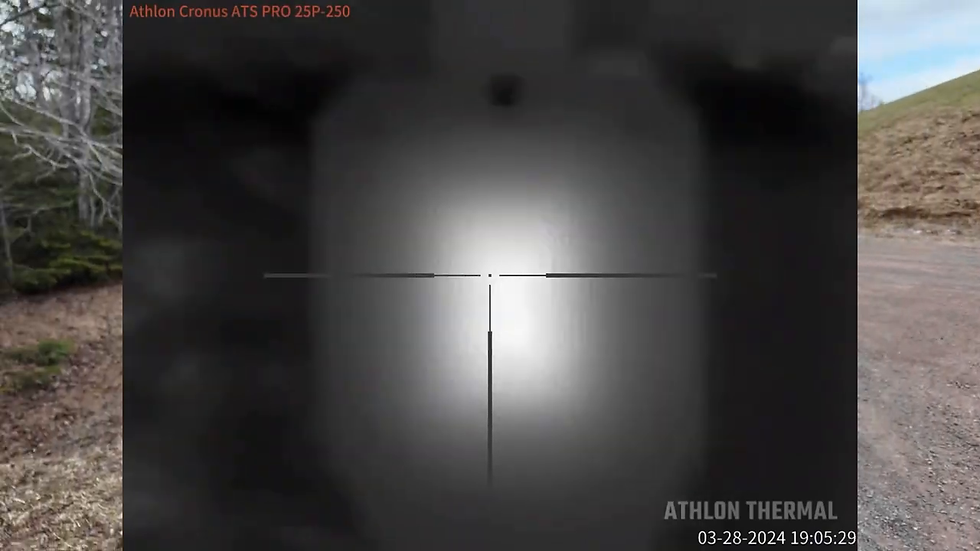
What makes a good zeroing target for thermal
The scope doesn't care how hot the target is. Thermal imagers resolve temperature differences under 1°C — what matters is contrast and edge definition. A target that's 15°C warmer than the background with a sharp edge beats a 60°C blob every time.
The DRX1 Electric Thermal Optic Target was built around exactly this: a steel IPSC silhouette with a rear-mounted heater that warms the plate evenly, with a temperature dial so you can set the signature — human-body warm for realistic training, or hotter for maximum contrast at distance.
Spec | DRX1 Electric Thermal Optic Target |
Temperature | Adjustable, up to ~100°C |
Runtime | 5 hours at 100 W (big battery) |
Charge time | ~6 hours from dead |
Cold-weather proof | Filmed at −10°C, clear signature at 30 W |
Visibility | Out-glows a human at 300 m, unmistakable at 400 m, visible at 600 m |
Impact indication | Warm bullet strikes visible through the optic |
Weather | Any rain is fine; just don't submerge it |
Electronics | All behind the steel plate |
Full-silhouette heat signature, not a hot dot
Crisp aim point at zeroing distances — aim small, miss small
One-shot zero: see your impact through the scope, correct, confirm
Two spare heater elements ship in the box
Works in the dark, overcast, fog, and snow — it radiates its own heat

FAQ
How do you know where you hit on the hot steel? Walk down there?
No. Bullet impacts on heated steel show up warm through your thermal scope — the strike reads clearly against the plate's even signature for long enough to measure and correct. You fire, see the hit, adjust, and fire again from the bench.
Why did my group move 5 inches when I adjusted 2?
Almost always a method mix-up. Freeze-frame and on-the-fly adjustments move the reticle in opposite directions, and most manuals don't say so. Pick one method, verify the direction with your first correction, and don't switch mid-zero.
At what distance can I see it? My mate struggles to see his target past 50M.
A full-size warm IPSC silhouette is a different animal than a hand warmer — you're looking at a man-shaped heat signature, not a faint 1" square. It out-glows a human at 300 m, is unmistakable at 400, and visible at 600.
Does it work in the dark or when it's cloudy?
Yes. The target radiates its own heat instead of reflecting the sky, so dark, overcast, fog, and snow don't matter. It's been filmed glowing against a −10°C background through a thermal optic.
Why not just tape hand warmers to the target?
Because you've already tried that: they turn into 6-inch blobs of heat, one good hit ends them, and they quit in cold weather. A hand warmer gives you a fading blob to aim at; a heated silhouette gives you a crisp edge that survives the hit and shows your impacts. More in hand warmer thermal target problems.
How long does the battery last?
Five hours on a charge — 5 hours at 100 watts holds a 66% IPSC plate at 100°C. Recharge from dead is about six hours. At −10°C the target held a clear signature drawing only 30 watts, so cold sessions don't gut the battery.


Comments