
Why Hand Warmers Make a Bad Thermal Target (the 18-Shot Zero)
Hand warmers make a bad thermal target because the heat bleeds through the backing and turns a 1" aiming point into a 4–6" blob on your optic. You end up zeroing to the center of a fuzzy circle instead of a defined point, and the first solid hit usually kills the warmer anyway. Add the 30–60 minute activation wait and a shelf life problem, and the cheapest option on the shelf becomes the most expensive way to burn a box of ammo.
That Short is the status quo at almost every night range in North America: hot hands taped to cardboard or steel. It sort of works, which is why everyone starts there. Here is why almost everyone stops.
Why does a hand warmer bloom on a thermal scope?
The iron powder inside a hand warmer heats the whole pouch, and that heat conducts into the tape, the cardboard, and the target face around it. Your thermal optic doesn't see the 1" square you cut. It sees everything the heat has soaked into.
One shooter described the standard trick and the standard result: "We cut hand warmers into 1" squares and taped them, but that turns into 6" blobs of heat." Another put a number on what he was actually aiming at: "I've always had the heat bleed and ended up aiming at a 4" circle."
That bloom is what wrecks your zero. A thermal scope resolves temperature differences under 1°C, so the optic is plenty precise. Your aiming point isn't. Here's how a 5-round zero turns into an 18-round session:
You aim at the center of the blob, but the blob has no center. Your hold wanders shot to shot.
Your group looks bigger than it is, because your point of aim moved between shots, not your rifle.
You adjust the turret to chase a group that was never a real group.
You re-shoot, re-adjust, and re-shoot again until you run out of light, warmers, or patience.
If you're working through a proper zeroing process, we cover the full procedure in how to zero a thermal scope. No procedure survives a 6" aiming point.
One good hit and it's done
A hand warmer is a plastic pouch of powder. A bullet is a bullet. "I used to use hand warmers but one good hit and it's done."
That's the fragility problem: the better you shoot, the faster you destroy your own target. Center your first shot and you've blasted the pouch open, dumped the powder, and now you're walking downrange to tape up a new one. On a cold night with gloves on. Every few rounds.
Compare that to heated steel. In our live-fire footage the target takes hits with "no issues at all" — the heat signature appears on the optic within 10 seconds of powering on, and impacts show up as visible marks on a silhouette that keeps glowing. The steel is the armor. On the DRX1 Electric Thermal Optic Target, all the electronics sit behind the plate, so shooting the target is the point, not the failure mode.
The 30–60 minute wait, expiry, and cold weather
Bloom and blast-out are the big two. There are three more failures that show up every session:
Activation lag. "You gotta open the hand warmers up 30-60 min before you hit the range." Forget to crack them open in the truck and you're standing around in the dark waiting for iron powder to oxidize.
Expiry. Hand warmers are a chemical reaction in a sealed pouch. Old stock and pouches with compromised packaging run weak or dead. You find out at the range, not at the store.
Cold and wet kill the contrast. The colder and windier it is, the faster a small pouch dumps its heat. The nights you most want to shoot thermal are the nights hand warmers fade fastest. Field reports on foil-tape and heat-pack hacks in snow read the same way: fine in the garage, gone at 6 degrees and snowing.
Hand warmers are one entry on a long list of workarounds — foil tape, water jugs, propane heaters. We tested the whole list in DIY thermal targets: what actually works.
Hand warmer vs heated steel: the numbers
Spec | Hand warmer on steel | DRX1 Electric Thermal Optic Target |
Aiming point | 4–6" heat blob | Full IPSC silhouette, crisp steel edge |
Time to signature | 30–60 min activation | On the optic within 10 seconds |
Survives impacts | One good hit and it's done | Live fire, no issues; impacts stay visible |
Runtime | Fades as the pouch cools | 5 hours at 100 W on the big battery |
Temperature | Uncontrolled, decaying | Set it, up to ~100°C on a 66% IPSC plate |
Cold weather | Fades fast in wind and cold | Proven at −10°C on just 30 W |
Detection range | Shooters report losing it past 50 m | Out-glows a human at 300 m, unmistakable at 400 m, visible at 600 m |
Per-session cost | New warmers and tape every trip | Recharge overnight (~6 hours from dead) |
The visual difference is the whole argument. This is what a hand warmer setup gives your optic:
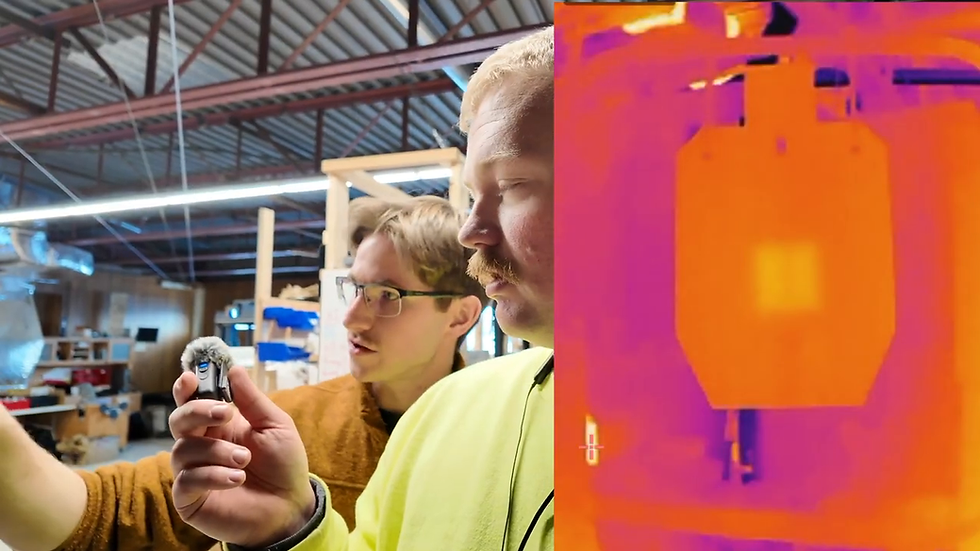
And this is what heated steel gives it:

A blob with no edges versus a man-shaped signature with a defined border. Aim small, miss small only works if there's a small thing to aim at.
What to use instead
Two options fix the problems above, and both come from Dynamic Range X1.
The DRX1 Electric Thermal Optic Target is the temperature-controlled flagship. Dial the silhouette anywhere up to ~100°C — human-body warm for detection training, or hotter for maximum contrast at long range. The big battery runs 5 hours at 100 W and recharges in about 6 hours. It's the target for long-range and low-light precision work, tested outdoors at −10°C.
The DRX1 Solid Fuel Thermal Optic Target is the simple, rugged option: a welded steel firebox that bolts to the upper mounting holes of an unmodified IPSC silhouette and burns regular retail briquettes. Three or more hours of heat per fuel load, no batteries, no electronics, built for short-range sport and training sessions.
Either way, your zero lands on a steel edge instead of the middle of a fading blob.
FAQ
Why not just tape hand warmers to the target? It's called a hand warmer..
Because you've already tried that, and you know how it goes: the heat bleeds into a 6" blob, one good hit ends the warmer, and it fails outright in snow and real cold. A hand warmer gives you a fading blob to aim at. Heated steel gives you a full warm human silhouette with a crisp edge that survives the hit and holds its signature for hours.
How long does the battery last?
Five hours on a charge — 5 hours at 100 watts holds a 66% IPSC plate at 100°C. It ships with the big battery only, and recharge from dead is about six hours. At −10°C the target held a clear signature drawing only 30 watts.
At what distance can I see it? My mate struggles to see his target past 50M.
A full-size warm IPSC silhouette is a different animal than a hand warmer. The DRX1 Electric Thermal Optic Target out-glows a human at 300 m, is unmistakable at 400, and visible at 600. Thermal imagers resolve temperature differences under 1°C, so contrast carries — not raw heat.
What happens when I shoot the heater?
You won't in normal use — all the electronics sit behind the steel plate, so the target is designed to be shot. If a round does find the heater, it's likely only the element that needs replacing, and two heater elements ship with every unit.
Does it work 24 hours? Does humidity effect it? Does it work in the dark or when it's cloudy?
Yes. The target radiates its own heat instead of reflecting the sky, so dark, overcast, fog, and snow don't matter. Any rain is fine — it just can't go underwater.
How long does it stay hot? Hand warmers cool too quickly.
The DRX1 Solid Fuel Thermal Optic Target runs three hours or more per fuel load, unattended, holding at least 20°C above ambient across the target face. The DRX1 Electric Thermal Optic Target holds whatever temperature you set for 5 hours on the big battery.


Comments